The 45 Minutes No One Is WatchingWhy passive containers need evidence between cold-hold release and handover.PDF - public article brief
Download ›GCCAP article
The 45 Minutes No One Is Watching
The most fragile part of a cold chain is often the short trip between controlled rooms.
EVIDENCE SUPPORTGCCAP reports observed temperature behaviour and evidence quality. It does not certify food safety, declare legal compliance or assign liability.
GCCAP ARTICLEGCCAP
Article
The gap is not dramatic. That is why it gets missed.
Most cold-chain failures do not begin with a dramatic breakdown. They begin in ordinary minutes: a cart waiting near a dock, an insulated crate sitting beside a loading bay, a delivery held while paperwork catches up, or food staged before the next handler is ready.
Inside the kitchen or production room, temperature control is usually visible. Fridges have logs. Cold rooms have alarms. Staff know where the checks happen. But once food is packed into a passive container, the story changes. The food is still moving through a cold chain, but the container itself has no powered cooling and no window into what is happening inside.
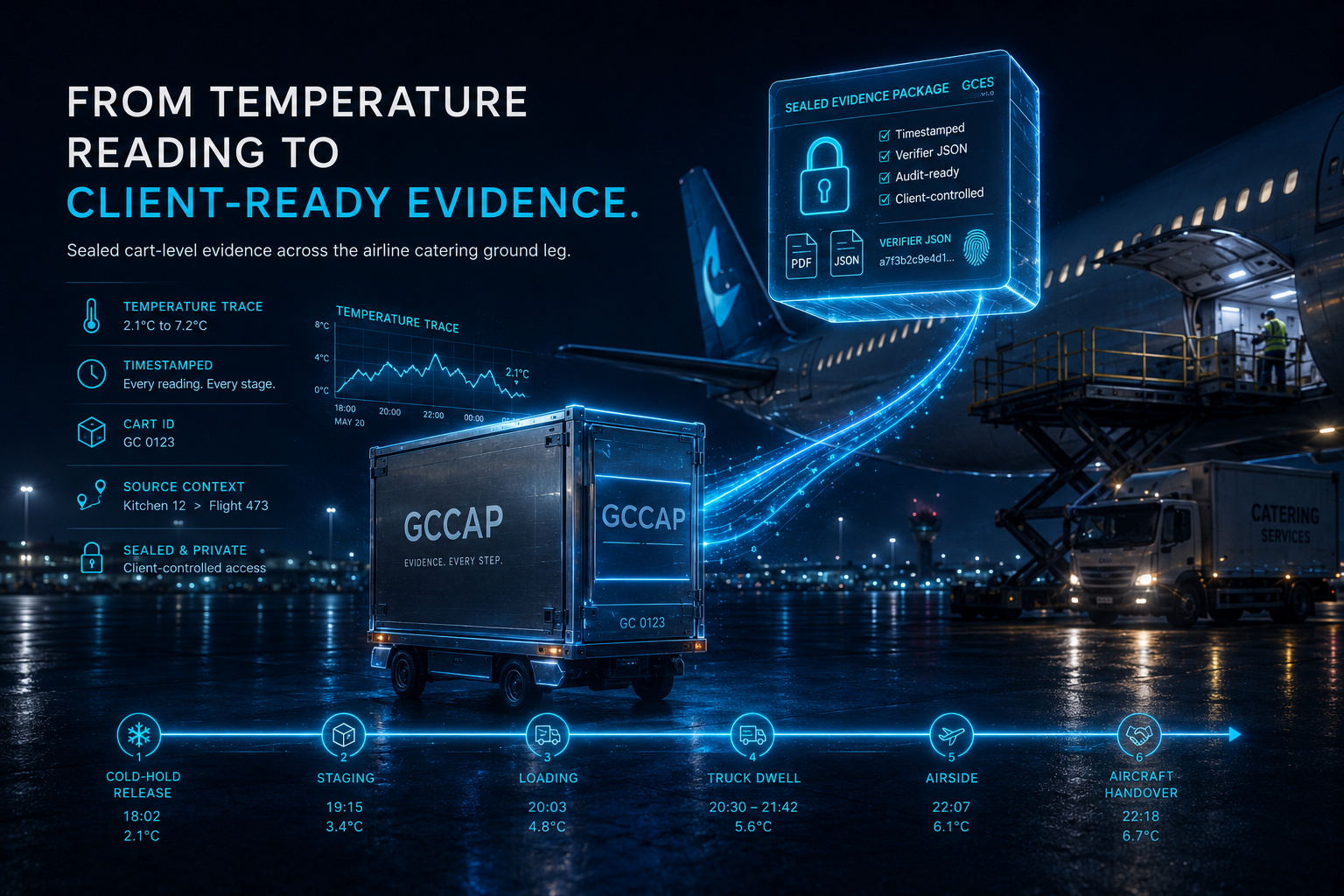
That is the 45 minutes no one is watching. In airline catering it may be the ground leg from cold-hold release to aircraft handover. In healthcare meals it may be the trip from kitchen to ward, facility, van or receiving bench. In premium delivered food it may be the stretch between dispatch and customer handover. The sector changes. The evidence gap is the same.
Article
Why this matters to operators
Good operators are often the most exposed when something goes wrong. They may have done the right things inside their controlled facility, but once the product leaves that environment, the available proof often becomes thin. A paper dispatch time, a truck departure note and a receiving tick-box do not reconstruct what happened inside the container.
That matters because the first question after a complaint, inspection, spoilage event or insurance review is not usually philosophical. It is practical: show me the record. Show me when the food left cold hold. Show me where temperature changed. Show me whether the gap was in the kitchen, the dock, the truck, the tarmac, the ward, the facility receiving point or somewhere in between.
Without that record, everyone argues from memory. Memory is weak evidence. A sealed temperature record is better.
Article
The right standard is not more paperwork
The answer is not to make operators fill in another form. The answer is to create a record that follows the passive container and can later be reviewed without relying on recollection. That record should connect asset identity, sensor identity, time, temperature and handling stage. It should also say what it does not know.
This is where GCCAP’s position is deliberately narrow. GCCAP does not declare food safe. It does not decide legal compliance. It does not assign blame. It produces reviewable evidence showing observed temperature behaviour and the quality of the record behind it.
That is the missing layer for food that travels in passive containers: not another claim, but a better record.
Article
The commercial point
If you operate food that moves without powered cooling, the question is not whether you care about temperature. Of course you do. The question is whether you can prove what happened when the product was no longer inside the room everyone already monitors.
The future buyer will not only ask for traceability. Traceability says where the food went. Evidence says what happened to it while it moved. That distinction is where the next standard will form.
Takeaways
What the reader should remember
- 01
The evidence gap appears when food leaves a controlled room and moves in a passive container.
- 02
Traceability and temperature evidence are different layers; both matter.
- 03
Strong evidence reports what is observed and flags what is uncertain.
- 04
GCCAP supports review. It does not certify safety, declare compliance or assign liability.
Download
Take the article off-site
This PDF brief supports client, supplier-assurance, audit, insurer and procurement conversations.