What a Cold-Chain Evidence Package Should ContainThe minimum record set for food that travels in passive containers.PDF - public article brief
Download ›GCCAP article
What a Cold-Chain Evidence Package Should Contain
A useful evidence package is not a dashboard screenshot. It is a defensible record.
EVIDENCE SUPPORTGCCAP reports observed temperature behaviour and evidence quality. It does not certify food safety, declare legal compliance or assign liability.
GCCAP ARTICLEGCCAP
Article
Evidence is not the same as visibility
A dashboard can show what is happening now. An evidence package must explain what happened then. That difference matters after an exception, complaint, audit, insurance review or supplier assurance question.
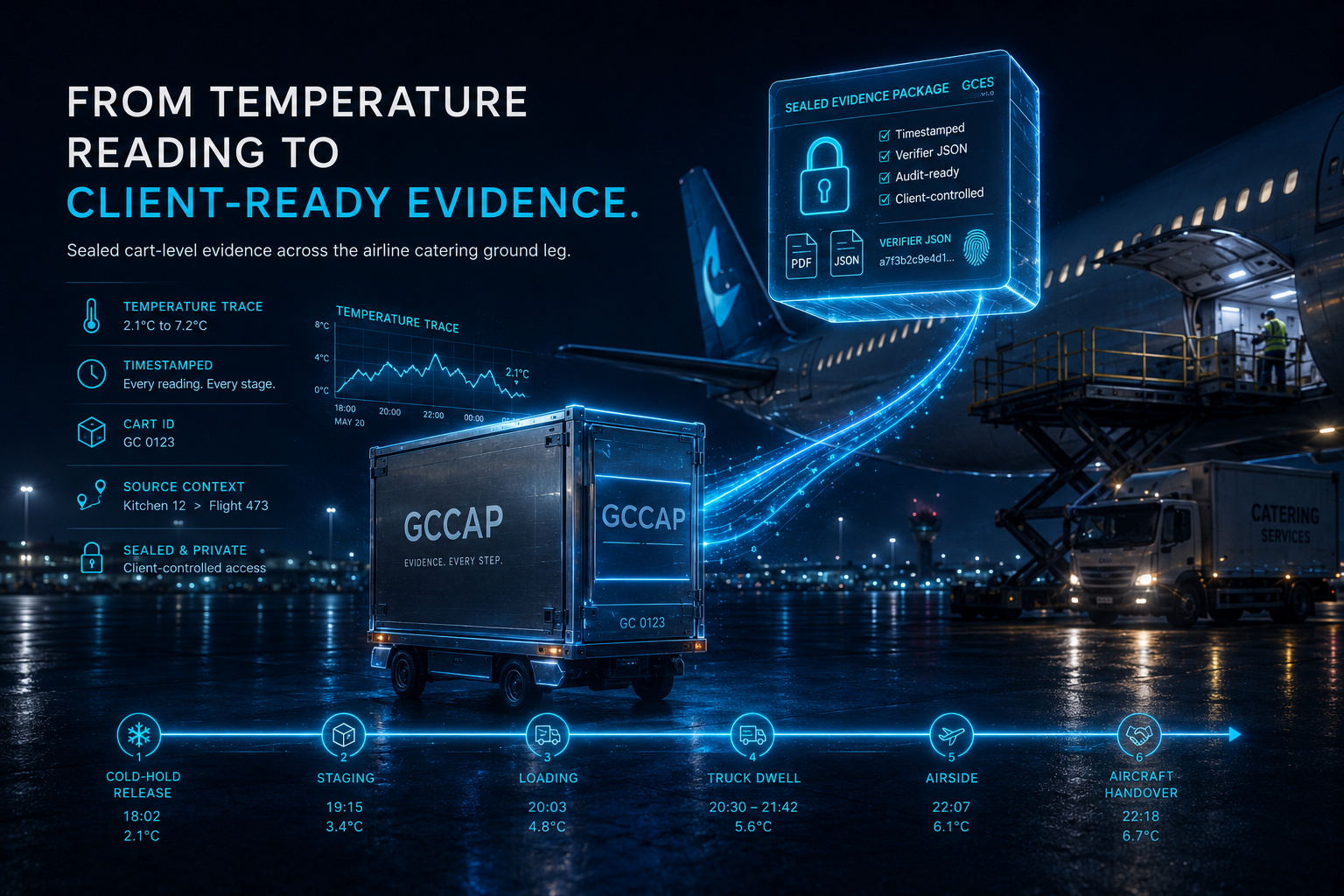
For food that travels in passive containers, the record needs to survive more than a quick glance. It has to connect the reading to the asset, the asset to the journey, and the journey to a timeline that can be reviewed later. A screenshot alone is weak because it is hard to reproduce, hard to audit and hard to reconcile with raw data.
Article
The minimum components
A serious cold-chain evidence package should include: raw sensor data, normalised model data, asset identity, sensor assignment, gateway identity, timestamps, stage reconstruction, exception flags, missing-data windows, precision notes, calibration references where available, and a client-safe summary.
It should also keep the uncomfortable parts. If the gateway did not hear the sensor, say so. If a reading was coarse precision, flag it. If a record shows presence without temperature, do not pretend it is a measurement. The fastest way to destroy trust is to make the evidence look cleaner than it really is.
Article
Why passive-container food needs this
The evidence need is strongest where food moves through time and space without powered cooling. In airline catering, that means carts and the ground leg. In healthcare or delivered meals, it may mean crates, insulated boxes, vans, wards or receiving points. In each case, the buyer wants assurance and the operator needs a record that can defend good process.
A lot code can say what batch the product came from. It does not prove the temperature behaviour of the container during the journey. That is why traceability and temperature evidence should be treated as different but complementary layers.
Article
The GCCAP boundary
GCCAP’s role is to produce sealed evidence that supports review. It is not to certify food safety or declare legal compliance. That boundary is important because it makes the evidence more credible, not less. The strongest record is the one that shows what it knows, what it does not know and where the review should focus.
Takeaways
What the reader should remember
- 01
The evidence gap appears when food leaves a controlled room and moves in a passive container.
- 02
Traceability and temperature evidence are different layers; both matter.
- 03
Strong evidence reports what is observed and flags what is uncertain.
- 04
GCCAP supports review. It does not certify safety, declare compliance or assign liability.
Download
Take the article off-site
This PDF brief supports client, supplier-assurance, audit, insurer and procurement conversations.