What Temperature Evidence Means for Food That TravelsA safe, client-facing evidence article without overclaiming legal conclusions.PDF - public article brief
Download ›GCCAP article
What Temperature Evidence Means for Food That Travels
The practical issue is not only rules. It is whether the business can substantiate what happened.
EVIDENCE SUPPORTGCCAP reports observed temperature behaviour and evidence quality. It does not certify food safety, declare legal compliance or assign liability.
GCCAP ARTICLEGCCAP
Article
The wrong way to talk about regulation
The fastest way to weaken an evidence business is to overclaim the law. No client should be told that one vendor, one sensor or one platform automatically makes them compliant. That is not how serious buyers think, and it is not how GCCAP should speak.
The better question is practical: if your process depends on temperature control, can you produce a record that supports review of that control? For food that travels in passive containers, that question becomes harder because the riskiest period may happen away from the fixed rooms that already have logs and alarms.
Article
Substantiation is the commercial issue
Food operators, caterers, healthcare kitchens and airline suppliers all understand procedures. The issue is substantiation after release from a controlled environment. Once product is packed, staged, loaded, moved, handed over or received, the evidence often fragments.
That creates risk even when the team is diligent. The facility record may be strong, while the moving-container record remains thin. A review then becomes dependent on summaries and memory rather than a sealed journey record.
Article
What evidence should support
A good evidence record should support audit preparation, client assurance, exception review and incident reconstruction. It should make the review easier without pretending to replace professional judgement.
That is why GCCAP uses evidence-support language. It reports observed temperature behaviour, evidence completeness, missing-data windows and exception flags. It does not certify compliance, declare safety or decide liability.
Article
The practical standard
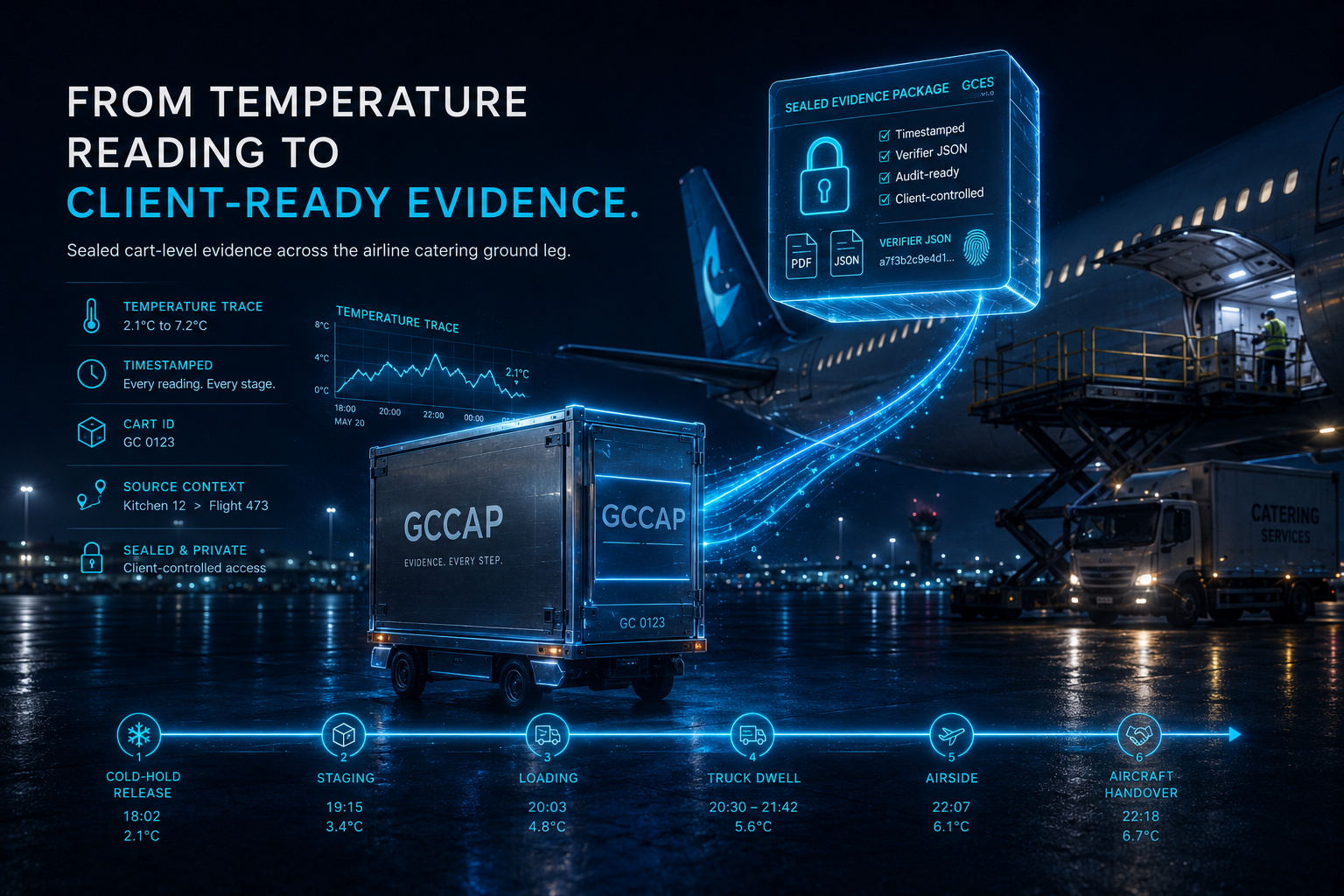
The practical standard for food that travels is clear: the record should follow the container. If the product moves in an airline cart, insulated crate, ward trolley or delivered-meal box, the evidence should not stop at the cold-room door.
This is where the market is moving. Not toward louder claims, but toward better proof.
Takeaways
What the reader should remember
- 01
The evidence gap appears when food leaves a controlled room and moves in a passive container.
- 02
Traceability and temperature evidence are different layers; both matter.
- 03
Strong evidence reports what is observed and flags what is uncertain.
- 04
GCCAP supports review. It does not certify safety, declare compliance or assign liability.
Download
Take the article off-site
This PDF brief supports client, supplier-assurance, audit, insurer and procurement conversations.