Why Paper Logs Fail After a Food-Safety IncidentWhy incident review needs sealed evidence, not after-the-fact paperwork.PDF - public article brief
Download ›GCCAP article
Why Paper Logs Fail After a Food-Safety Incident
Paper can record a check. It rarely reconstructs a journey.
EVIDENCE SUPPORTGCCAP reports observed temperature behaviour and evidence quality. It does not certify food safety, declare legal compliance or assign liability.
GCCAP ARTICLEGCCAP
Article
A paper log is not a journey record
Paper logs are useful for showing that a check was performed at a point in time. They are not built to reconstruct what happened across a moving cold chain. That distinction becomes painful after an incident.
When a complaint, inspection, spoilage event or insurer question arises, the review team does not only need to know that someone checked a fridge. They need to understand the period between controlled points. When was the product released? How long was it staged? Did it sit in a passive container? Was it near a warm dock, a vehicle, a trolley bay, an aircraft door, a ward, a receiving point or a customer handover area?
Paper struggles because it depends on human entry, usually at the beginning or end of a process. The risk sits in the middle.
Article
Why honest operators still look exposed
The weak part is not always culture. It is evidence architecture. A diligent team can follow its process and still lack a continuous record of what happened once food left the monitored room. That is especially true for food in passive containers: airline carts, insulated meal boxes, ward trolleys, catering crates and other transport units that do not actively cool themselves.
After the event, the operator may know what probably happened. But a review does not run on probably. It runs on records. A missing record creates space for dispute. It also makes good performance harder to defend.
Article
What better evidence looks like
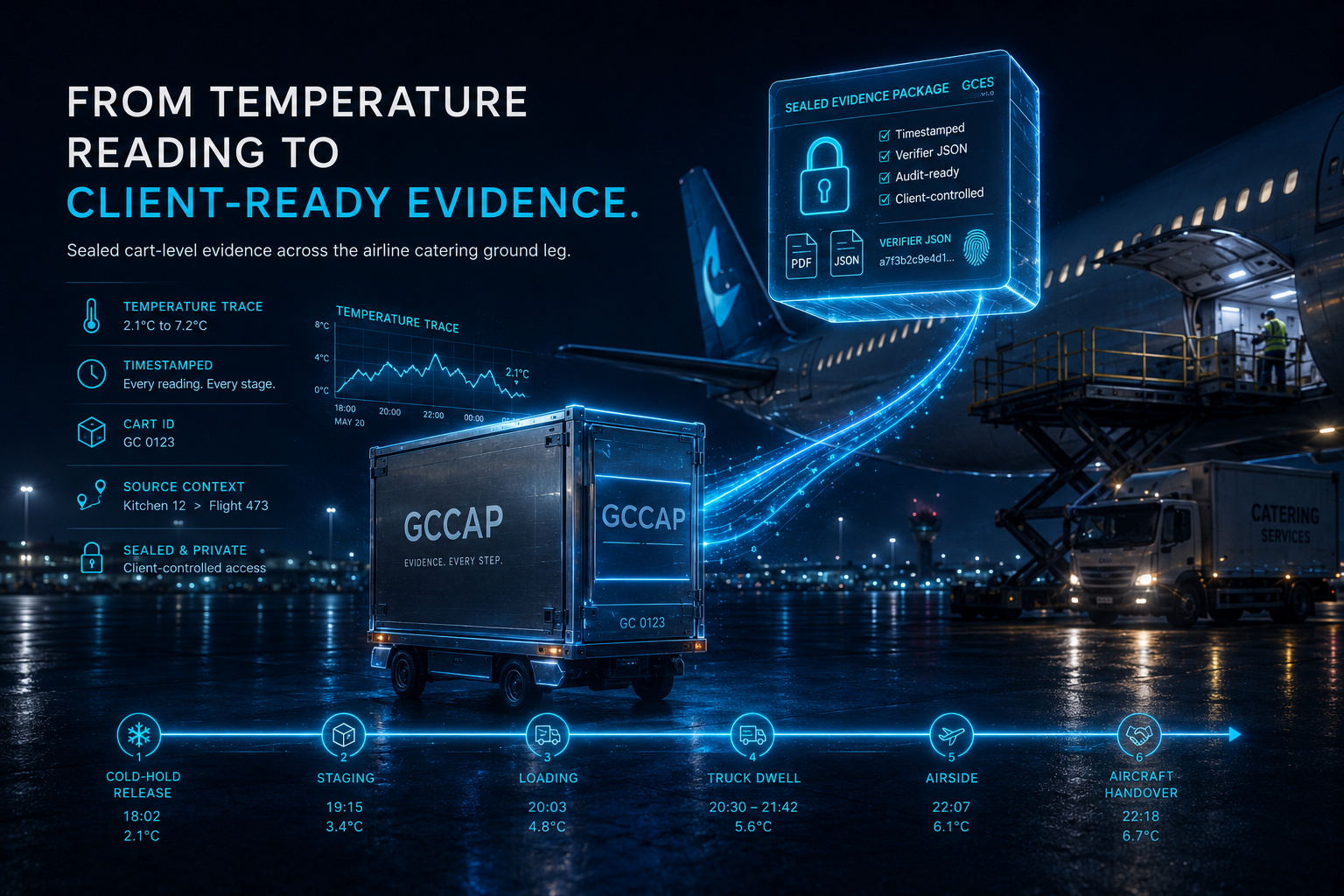
A useful evidence package should contain the raw record, a normalised record, a cart or container assignment, timestamp confidence, sensor identity, evidence-quality notes, missing-data windows and a client-safe summary. It should distinguish measurement from presence. It should flag coarse precision rather than quietly treating all data as equal.
That is not bureaucracy. It is protection. The purpose is not to create more documents. The purpose is to make the right document exist before a problem forces everyone to reconstruct the past from memory.
Article
The point for clients
If your food travels, your evidence has to travel too. Paper may remain part of the process, but it should not be the only record protecting the business when the cold-chain question becomes commercial, legal, operational or reputational.
Takeaways
What the reader should remember
- 01
The evidence gap appears when food leaves a controlled room and moves in a passive container.
- 02
Traceability and temperature evidence are different layers; both matter.
- 03
Strong evidence reports what is observed and flags what is uncertain.
- 04
GCCAP supports review. It does not certify safety, declare compliance or assign liability.
Download
Take the article off-site
This PDF brief supports client, supplier-assurance, audit, insurer and procurement conversations.