Why Food Temperature Incidents Are Hard to AttributeWhy attribution requires cart/container evidence, not only facility records.PDF - public article brief
Download ›GCCAP article
Why Food Temperature Incidents Are Hard to Attribute
When evidence stops at the facility door, everyone argues about the middle.
EVIDENCE SUPPORTGCCAP reports observed temperature behaviour and evidence quality. It does not certify food safety, declare legal compliance or assign liability.
GCCAP ARTICLEGCCAP
Article
Attribution needs a timeline
After an incident, people naturally ask who was responsible. That is often the wrong first question. The first evidence question should be: where did the temperature change occur?
Without a timeline, attribution becomes a debate between parties. The kitchen says product left in condition. The transport team says it moved as expected. The receiving point says it arrived late or warm. The client asks for proof. Everyone may be acting honestly, but the evidence is too thin to separate the stages.
Article
The passive-container problem
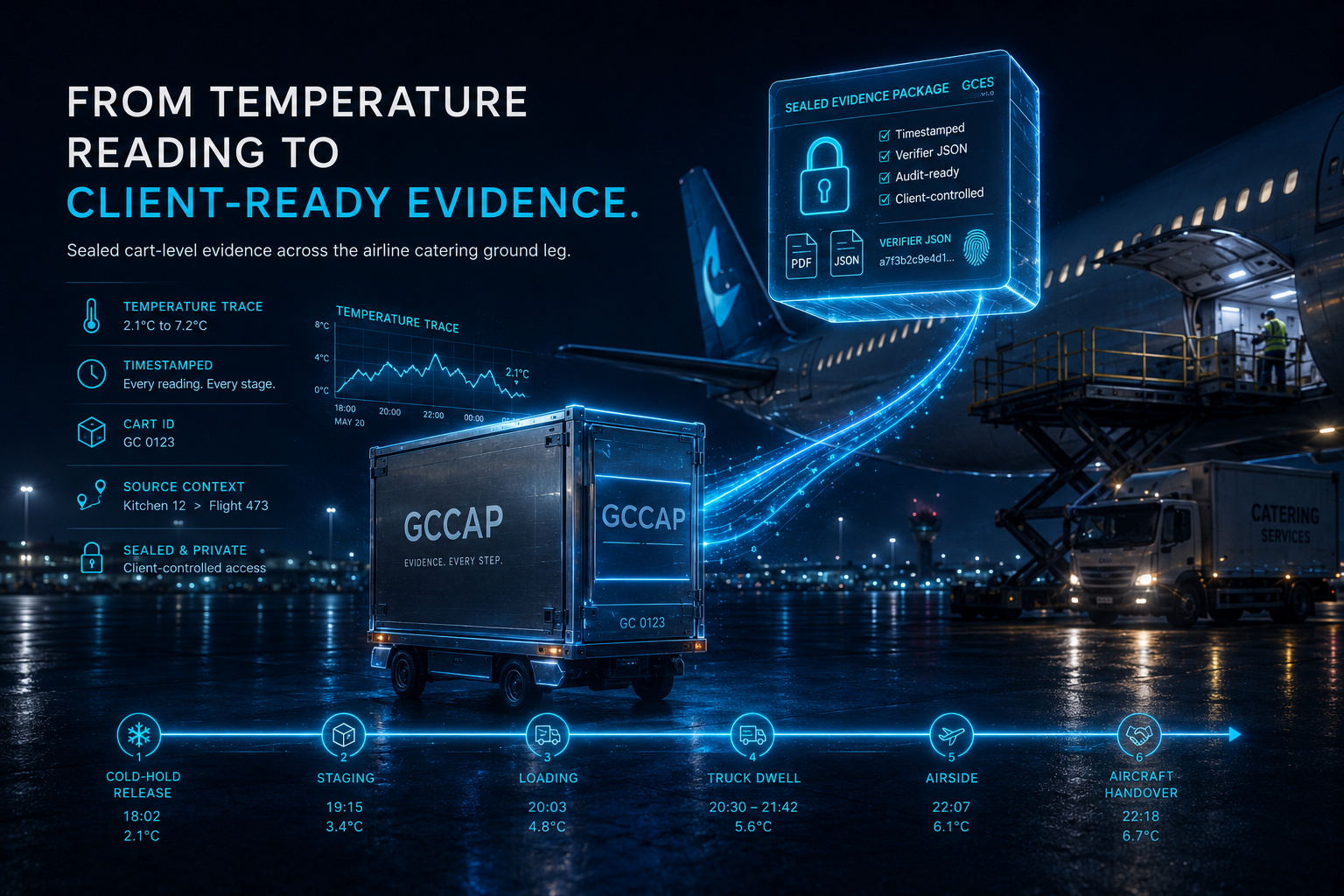
This is most obvious in airline catering, where a cart can move from cold room to staging, truck, tarmac and aircraft handover. But the same pattern appears in healthcare meals, aged-care distribution, event catering and premium food delivery. Food is placed in a passive container and the temperature story becomes harder to see.
Facility records and lot-code traceability are important. They do not automatically show the thermal behaviour of the container during movement. That gap is what makes attribution difficult.
Article
What better attribution looks like
Better attribution does not mean automatic blame. It means stage-level evidence. A useful record can show that temperature changed during staging, during a transport window, after handover, or during an unobserved gap. It can also show that the evidence is incomplete.
That last point matters. A trustworthy system must be willing to say when it cannot attribute a reading. If it guesses, it becomes dangerous. If it separates unattributed records and flags precision limits, it becomes useful.
Article
Why this protects good operators
The most valuable evidence system is not one that makes claims for the sake of it. It is one that helps a good operator prove what it did, identify where a process needs work and respond to a client or insurer with a structured record rather than a defensive explanation.
That is the future standard GCCAP is building toward: temperature evidence that travels with the food and supports review without overstating what the record can prove.
Takeaways
What the reader should remember
- 01
The evidence gap appears when food leaves a controlled room and moves in a passive container.
- 02
Traceability and temperature evidence are different layers; both matter.
- 03
Strong evidence reports what is observed and flags what is uncertain.
- 04
GCCAP supports review. It does not certify safety, declare compliance or assign liability.
Download
Take the article off-site
This PDF brief supports client, supplier-assurance, audit, insurer and procurement conversations.